I think I started going bald in High School. I didn't want to admit it then, and my hair had always been light and thin, but by the time I was a junior in college, I couldn't wear it over my ears anymore; an obliging female friend cropped it close. By last year, at age twenty-six, I was bic-ing my head as a reasonable solution, and wearing hats to keep my pate warm and un-sunburnt.
Now, it's not really so bad to be bald. One saves money on haircuts and hair products. Once the mild embarrassment always attendent on admitting the fact is overcome, then baldness is simply, well, a matter of fact. Many men wear it very well, with a sort of intellectual, statesman-like aura. It suggests a certain type of manliness, and unselfconsciousness when handled with aplomb rather than vague shame.
The irksome thing about being bald is the sheer monotony of it. There are essentially two ways of wearing baldness (discounting, of course, the tonsured pony-tail of the comic book connoisseur and geriatric Hell's Angel): the ring about the ears, or the full cue-ball. That's pretty much it. Sure, hats and glasses can dress up a look, but you're pretty much stuck with those two. And that is why I most envy those full heads of hair.
You might remember the old pen drawings in barbershops, the ones which show the essential types of hair cuts? Well those are all off limits. And bald isn't a choice. So never will I get to suavely comb my hair into a sweeping Draper part, never will I have a chance at a real barber haircut, never will anyone run their fingers through my luxurious hair.
Oh well. At least I save money, and Patrick Stewart and Michael Jordan are with me.
Wednesday, December 19, 2012

Monday, April 2, 2012
Farm Sitting
This week I am farm sitting for a local CSA family as they deal with a family crisis. Their newborn daughter (born at home) had to be rushed the hospital due to breathing problems, and then to Seattle where she remains hooked up to a huge machine. It is hard to even think about how difficult that must be for them, so of course I am eager to help any way I can.
It is heartening to see how people pitch in when its really needed. The neighbors here in Eagle have been great, and all sorts of folks have been helping the Hasselblads deal with this. On the farm, I have been trying to keep the option of running the CSA this year available.
So far that has meant building greenhouse vents, coordinating compost delivery, planting 500+ tomatoes, and tending dogs and goats. I must admit I enjoy the oddly strict freedom of farming: there are so many things to do, but no one telling me what those things are. I see the appeal. All the work I do feels rewarding, even as I know the pay off is months away, and still subject to failure. There is just something about working with soil, with living plants, and with animals that depend on me. It is responsibility at its most potent--no reprimands to deal with, only the steely and inflexible consequences of work performed well or poorly. These consequences ground everyday ethics in the world; it gives a whole new meaning to right living. It is easy to imagine how damaging sloth and greed, lust and wrath could be to a society that was built on hand labor planting and bringing in crops. It is clear to see how beautiful and essential human love is. It is easy to imagine how tightly knit farming communities could be when adversity is always just around the corner, and good times depend on good neighbors. In this way, as Wendell Berry points out, such community is like marriage. We agree to be in it for the long haul--thick and thin. We think it's worth it to love each other because we need each other. Not abstractly--really.
It is good to see this sort of community still exists. The steam of media which inundates our lives and tries so hard to define our reality, or the consumer economy which wants us to assuage isolation with purchases can't really provide space for this sort of community. Churches can, community groups and nonprofits can. Farms can. We're all in this together--and even though it might be easy to forget in the fat times, it is important to never lose sight of that.
If you are interested in knowing more about Eowyn Hasselblad or EvenStar Farm, please click on the links.
Monday, February 6, 2012
"The State of Nature"
In an article for the philosophy blog of the NYTimes, "The Stone," Steven Nadler writes insightfully about the 17th century philosopher Spinoza's unprecedented commitment to freedom of expression. He notes that Spinoza's conviction arises from the basic fact that beliefs and thoughts cannot be regulated. As the German volksong puts it: Die Gedanken Sind Frei, wer kann sie erraten. Thoughts are free, who can guess them. The song goes on to say that no one can know then, and no soldier can shoot them with powder or lead. We think what we like, no one can take away that freedom. Spinoza's (and Nadler's) argument runs that with such individual agency taken for granted, any attempt by government to keep people from expressing these free thoughts will only cause resentment and tyranny. Here is the final paragraph of the blog:
Well before John Stuart Mill, Spinoza had the acuity to recognize that the unfettered freedom of expression is in the state’s own best interest. In this post-9/11 world, there is a temptation to believe that “homeland security” is better secured by the suppression of certain liberties than their free exercise. This includes a tendency by justices to interpret existing laws in restrictive ways and efforts by lawmakers to create new limitations, as well as a willingness among the populace, “for the sake of peace and security,” to acquiesce in this. We seem ready not only to engage in a higher degree of self-censorship, but also to accept a loosening of legal protections against prior restraint (whether in print publications or the dissemination of information via the Internet), unwarranted surveillance, unreasonable search and seizure, and other intrusive measures. Spinoza, long ago, recognized the danger in such thinking, both for individuals and for the polity at large. He saw that there was no need to make a trade-off between political and social well-being and the freedom of expression; on the contrary, the former depends on the latter.
http://opinionator.blogs.nytimes.com/2012/02/05/spinozas-vision-of-freedom-and-ours/?hp
Interesting to me was a tiny phrase earlier in the piece, "state of nature". This came from a moment in the blog when Nadler was analyzing Spinoza's idea of restricted freedom of expression: sedition can still be banned when free speech steps over the bounds of civility and into the realm of inciting violence. Nadler claims this is because of the "social contract" that all citizens have tacitly entered:
As individuals emerged from a state of nature to become citizens through the social contract, “it was only the right to act as he thought fit that each man surrendered, and not his right to reason and judge.”
This all seems well and good, but that little phrase "state of nature" seems worthy of investigation. What is the "state of nature"? It seems here to indicate some savage, purely self interested sovereignty of cavemen. But that picture is surely invented, for all social groups even of animals today operate within bounds of affection, selflessness, and mutual responsibility (they probably don't call it that). Grounding the narrative of such a right in some imagined time period when all people were free and independent seems suspect.
So my response to this right is part classically conservative: what about the deep traditional mores of public discourse? Ought they not be maintained, with a countenancing of certain speech as allowable but deplorable? (Example: Holocaust deniers. We let them have their say, but don't give them credence). On the other hand I certainly believe that the minority voices, especially those condemning of the instruments of power, ought to be carefully protected, whether Rush Limbaugh or the Occupy Protestors. We can disagree with their messages, but must support their right to say it:
Libertas philosophandi, the freedom of philosophizing, must be upheld for the sake of a healthy, secure and peaceful commonwealth and material and intellectual progress.
Sunday, January 22, 2012
21st Century Education
Full disclosure: I am old fashioned by disposition. I rankle at the thought that "new" is always a selling point.
So, reading an article in the Sunday New York Times*: What You Really Need To Know, I went into curmudgeon mode.
The premise of the article is all too familiar. We are living in a new age, we need a new education. Information is more prolific and available than ever, collaboration is more important, we know more about how the brain works, data is king and so on. The failing point of this sort of Information Age exceptionalism is that fails to recognize several enduring truths.
The first, so often overlooked in the world of smart phones and data mining, is that information is not knowledge. Lawrence Summers, author of the article and former president of Harvard, conflates these two terms his first bullet point of his hopes for education: "Education will be more about how to process information and less about imparting it. This is a consequence of both the proliferation of knowledge--and about how much of it any student can truly absorb--and changes in technology" [emphasis added]. The trouble is, while information may easily be said to increase, knowledge is a more amorphous thing. Knowledge, after all, is that which is known. And for anything to be known, there must be a human involved; a know-er. That is to say that while one may understand how to search for a book in a library, one does not know all the information which is contained within that library's shelves. One may be able to access millions of books via Google, but one does not know what they say, or contain, or mean.
Summers's wish seems to be that students will be taught how to use a search engine effectively, how to sift through the sea of data to find the pertinent factoid. Perhaps they even made to do so several times--writing a few topical term papers to regurgitate information on assigned topics. Then they will be pronounced to have the ability to "process" information, like so much pig flesh becoming bologna. The trouble is, no one will know anything more than how to find information. Which information to find, which information pertains to the question at hand, which questions ought to be at hand for any given situation, and the knowledge of principles, are skills that are conspicuously missing. A person may be able to look up texts on bridge design, but we don't wish them to build our bridges unless they know the principles of engineering.
Next Summers goes on to criticize the tendency of students to be asked to achieve on their own. Collaboration, he states, ought to be the focus of education. Of course, groupthink has achieved many wonderful things; among them IBM computers, the hydrogen bomb, and thousands of ads and political campaigns (a telling linkage of the various uses of 'campaign'). Unfortunately, he forgets the fact that all learning is a collaboration. It is taking part in the great conversation of ideas through history. The best classes are collaborations between students and instructor, between texts and discussion. This is one of the most beautiful aspects of human creativity. And he also overlooks the fact that even in collaborative undertakings, individual achievement is the backbone of any success. Newton, Herschel, Goethe, or even current darling genius Steve Jobs were all individually driven. No matter how collaborative society may be, it is still incumbent on the individual to make extended, solitary intellectual effort. To work hard on what they believe in. Then they will inevitably share, and their ideas will be extended by others. But all students should be thrilled to hear that it is in the crucible of the individual mind that all ideas are put to the test. This is one of the most empowering aspects to be found in the history of ideas or education. Any individual can change history with ideas: Luther, Kant, Newton, Einstein. It would be a pity to quash the responsibility of the individual student because it is easier to track students' likes on facebook than ask them for sustained, lonesome thought on important subjects.
My final reason for dismay is his insistance that technology is a savior. Sure, some aspects of technology are great for opening access to scholarship, various ideas, allowing a democratization of dialogue. But as a teacher in the classroom, I can say that at times tech is a more a distraction than a help. The leg work which goes into maintaining most class websites, troubleshooting glitches, entering data &c. would be better spent planning lessons, reading texts, or conferencing with students. Most students want more content, and less flash. When they have to learn a new system of updating blogs every semester, they are less liable to really put thought into their reading. Technology might be useful certainly, but its invocation as a panacea has gone far enough, in the classroom and need not go further. It is more important that we ask "why" than "how much". One of the great aspects of reading great literature, philosophy, or history is its timelessness--not its reveling in the usefulness of print or the efficacy of letters. Ideas are the technology that is most likely to outlast obsolescence.
*which I get physically, on newsprint, delivered consistently to my neighbor's driveway, despite attempts to inform the delivery person of my actual location.
Friday, January 20, 2012
What is Nature?
This was just a little freewrite from my class "The Idea of Nature in the Long 18th Century".
What is nature?
Nature is everything that exists beyond (or prior to) human
control. By human control, I mean
conscious thought—our designs, to borrow an outdated use of that word. If this is the definition of nature, then
another way to put it is the essentially nonhuman aspects of the world.
It is
important to have a word and concept for this odd thing. Otherwise how can we share our itching
suspicion that the crystalline make-up of minerals and our own intractable
tendency to eat, sleep, and get distracted share some basic traits? They are both beyond our control, they
existed before we did, and they are unlike the Roman Empire or binary
code. They are not of human design, but
rather from the material world: beyond human dasein.
To borrow
another Heideggerian idea, nature is first and foremost that which is
present-at-hand. It is the material
stuff of the world, before meaning.
However, amazingly, it also has an order and a meaning inherent to
it. It is present-at-hand in that
various (mostly living) aspects of nature exist in a dymanic web of functions,
causal relationships, and symbiotic webs.
This is what we have come to recognize as ecosystems, and ecology. The “system” of the nonhuman world.
Of course, though,
humans are embedded in this world. We
are made up of stuff that isn’t us, and we everything we design is designed
from things that at root, weren’t designed.
And yet there is some sort of morality inherent in nature. There are things which can go “against”
nature—both human nature and the “green” nature of ecosystems. The more I learn about this aspect of nature,
the more I come to see culture (collectively taken as everything that is of human design) as struggling to
cope with its place in larger nature.
This struggle is bound up in our type of existence, which has to take a
stand on our own being. Nature—by
definition—does not have to do this.
Tuesday, January 17, 2012
A Republic of Letters
During the period now called the Enlightenment, from the late 17th through the 18th and 19th Century, there was a "Republic of Letters". The various "philosphes" of Europe and the eventually the New World shared their ideas, their theories, and their lives by mail. Their correspondence was prodigious--my volume of the letters between the German thinkers Goethe and Schiller is over 500 pages long. They shared everything from poems to garden seeds--the thirst for knowledge was omnivorous. They respected one another's cultural differences, indeed reveled in them--practicing foreign idioms on each other. They also had their rivalries, each trying to outdo the other in advancing knowledge. Yet it is hard not to think of their time as somehow more innocent than ours, their motives for intellectual work more clear. They wished to expand knowledge for its own sake--to improve the life of all, not necessarily for their own profit (indeed their own societies often forbade profiting by their experiments).
In our day such idealism is scoffed at or derided as the mark of privilege. Certainly those were privileged men, but they recognized their privilege and tried to espy all the further into the working of the universe because of it.
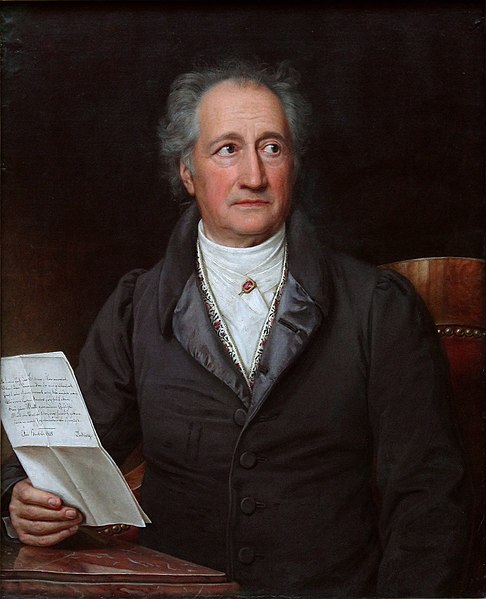 |
| Johann Wolfgang von Goethe |
Monday, January 16, 2012
Pear Trees and Pub Quiz
In hopes of inspiring now-term and long term community, I have been working on a few projects lately. One has to do with pomes, and drupes, or seed fruit and stone fruit as they are more commonly known. Pomes are apples and pears, while drupes are plums and cherries. It just so happens that there is a beautiful bBarlett pear tree in the back yard of the apartment I live in. In fact, the tree sits right in the middle of the chicken pen. Last spring, it bloomed beautifully--probably because it is on the north side of the building, so it doesn't bloom too early and get frosted. We had a bumper crop of pears ripening all summer long. Finally, in September, the squirrels proceded to eat every last pear. I have since learned that pears should be picked and stored for a few weeks to ripen, and I might have been able to save the crop from the squirrels.
But enough background. My current project is going to involve pruning the neglected pear tree (though someone clearly cared for it once, long ago) and asking permission of the neighbor to prune his gigantic juniper so there won't be squirrel access. I hope the chickens, who don't really let the squirrels around, will keep them off the tree for the most part. We might actually get to eat some pears this year! Furthermore, I am going to try to use the prunings to propagate the tree. That part is an extra longshot though, so we'll see if it works. I also have a plum tree that I transplanted from my grandparents garden, which grew from a stone. I am curious to see if it makes it though the winter in it's pot on the screened front porch.
On another non garden front, I started a pub quiz. That is the now term project. Last night was the first ever Papa Joe's pub quiz, featuring questions such as: What is the name for all tree fruit with seeds rather than stones? (now you know!); what are the sports of the modern pentathlon?; what is the first name of "Butch" Otter, &c. It was a hoot, and there were at least 30 people there, enough for six teams of five-six. I think everyone had a good time, though I might have to throw a few more gimmies in the mix; the top score was 11 of 30.
It was really good to have a pub quiz like the one I used to go to in Europe. Working with friends to solve problems and answer trivia does a lot to build community. You get to see the styles of argument, who is pushy and who retreats, who has what surprising fact tucked away in their brain from their unique life experience. I look forward to more of these.
Thursday, January 12, 2012
My Teaching Philosophy
Statement of Teaching
Philosophy
My philosophy as a teacher and scholar is rooted in the
values of the liberal arts. I have a
deep-seated belief in the power and value of ideas. This leads me to estimate the value of
education as going far beyond the oft-quoted statistics showing more per capita
income to college graduates. Rather, my
belief is that the value of education lies in its ability to improve the lives
of individuals, and in so doing to improve society. This places a huge and
exhilarating responsibility on teachers: to shed light on the hidden power of
ideas, empower students to make use of those powerful ideas, and help them see
the inherent value of careful thought.
Tuesday, January 10, 2012
San Francisco, 1857
As part of my graduate school, I am currently working on a research project with a professor of mine, searching out stories of male partners during the California Gold Rush. To find these stories I have been reading through issues of two magazines published in San Francisco in the 1850s. One is called The Pioneer, the other Hutchings' California Magazine. Both are digitized and can be read for free online.
Reading these magazines, which were circulated throughout California at the time, is as close to time travel as I have ever come. The pages are filled with general interest pieces on mining, industry, and transportation; tales of adventure and sentimental romances; and odd editorial declamations on poetry or social customs in San Francisco. I, just like the original readers, am caught up in curiosity. I can't wait to read about the workings of a quartz mining stamp mill or the processes of quicksilver refining. It is all new, all fascinating. To hear the stirring and bold designs of mid-19th century America makes me want to light out for the territories myself. Yet, for me, the inevitable chagrin of historical hindsight also lurks in these pages. The story of Gen. Sutter, as told by himself, is especially poignant.
Reading these magazines, which were circulated throughout California at the time, is as close to time travel as I have ever come. The pages are filled with general interest pieces on mining, industry, and transportation; tales of adventure and sentimental romances; and odd editorial declamations on poetry or social customs in San Francisco. I, just like the original readers, am caught up in curiosity. I can't wait to read about the workings of a quartz mining stamp mill or the processes of quicksilver refining. It is all new, all fascinating. To hear the stirring and bold designs of mid-19th century America makes me want to light out for the territories myself. Yet, for me, the inevitable chagrin of historical hindsight also lurks in these pages. The story of Gen. Sutter, as told by himself, is especially poignant.
Monday, January 9, 2012
The Body Politic
In an attempt to rigorously test and chronicle my own thinking, I have decided to take up this blog once more. The topics covered previously may crop up again, but the posts will likely take a new tack and become more engaged with my lived intellectual endeavors and concerns.
The title of my blog still fits. I still believe the bicycle to showcase the most noble traits of human ingenuity and potential. Bicycles are elegant machines: lightweight, ingenious, and adaptable. They produce no waste, the skills to use and fix them are easy to learn, they multiply human mobility tenfold, and they help individuals achieve freedom of mobility. Bicycles let us be free, they are cheap, they last, and they are egalitarian. Bicycles embody the best of "progress".
The other object in the title, the lariat, then, embodies "tradition". Still the best way for a cowboy to catch a calf, bull, or even horse, the lariat is simply a stiff rope. It is the learned manual skill of the worker that makes his tool so effective. The individual must perform within his inherited culture, must understand how to navigate the physical world, must do well. The lariat requires the craftsmanship and care of the user--it requires respect for one's place in the larger order, and individual achievement.
The tension between these two values, progress and tradition, is at the core of my path through life. On this blog, I hope to explore a wide range of topics, issues, and philosophies which I encounter as I try to make my unique way through life.
Tuesday, May 4, 2010
Frühling
The trials of winter are melting off. The cold that kept the world looking pure and clear in brilliant contrast, but punished it in darkness and drove life to ground has lost its grip. Green has again risen and draped the city in mercy. My window no longer looks out to empty dirty walls and sticks. Now a soft and soporific verdure spreads itself further everyday, relaxing its way out and down and settling. The parks are carpeted and cushioned and canopied. The leaves have burned from pale yellow dusting to a full even hue, pulling in rain and breeze. Pulling creatures out and up.
The city is again full of people. So full it makes one wonder where they have been. To walk through the old town on a sunny afternoon is to see the city by its face and not its facade. Shoppers, ice cream eaters, people watchers, peddlers, dog walkers. Old women in high heels and cheap shimmery tops that seem to defy categorization with glittering gold lipstick sip coffee in the middle of the pedestrian section. Flocks of school children dressed in neon clothing made for people three times their size blur around and through the crowds like swifts around chimneys. Old men in lederhosen with hats and canes carefully rummage through the town, watching the young sharp lined business men stride by seeing nothing and arguing into a cell phone.
Pears swell where two weeks ago blossoms sang next to the southwest walls. A soft rain tints the mountains a deep indigo and pearly clouds tear off the slopes in downy filigrees. Every where the promises of summer are visible. Promises I will not be here to enjoy, for my promises lie elsewhere.
Monday, March 29, 2010
Föhn
Innsbruck is an old city. Buildings in the old town bear cornerstone inscriptions of 1524, 1487, 1348. A bridge has spanned the river Inn since Roman times, when this was the eastern edge of the province of Noricum, a way station on the salt road winding north to the border forts on the Rhine. And so the people here are old in a way Americans find easy to dismiss. Old and superstitious, old and arcane, old and full of awareness out of step with modernity. They possess an affinity with intuition, a catalogue of inherited tales, and a folksy suspicion of the efficacy of modern methods of all flavors. Like their capital in Vienna, Austrians, I dare say even Europeans are a people of the past. Their moment in world history may have slipped past and now they argue and bicker and worry about how best to preserve the things they think define them, but they also have more unashamed access to tradition without self-consciousness.
I could take as an example of this some ancient pagan festival, and have before in other posts; I could critique the spittle and velvet glove populism of the xenophobic right and nanny state regulatory politics of the self satisfied left; I could point to the enduring localization of foods and dialects. But I won’t. What is more interesting are the differences so deeply anchored in the Austrian mentality that the Austrians aren’t even able to see them. Their understanding of the world, their clarifications and reasons and sense making, their myths.
I don’t mean myths as coherent stories with beginnings and ends and heros. I don’t even mean they are wrong. I just mean the network of more or less unquestioned thought processes that I have slowly come to find amusing, infuriating, and fascinating by turns.
One myth I have witnessed in action, and even have to respect, centers on the Föhn. The Föhn is a wind. In fact, in Innsbruck Föhn is almost synonymous with wind. If it’s blustery, its föhn-y. The Föhn is more than just a wind however. In modern scientific terms it is an adiabatically warmed wind, blowing down the lee side of a mountain range. That is to say that it is a mass of air that moved up the far side of the mountain range, lost its moisture due to cooling at higher altitude, then warming again at a faster rate than it cooled as it is drying on the way down. It is the Alpine version of a Chinook or a Santa Ana. It is also plays havoc with the inhabitants.
The Föhn has obviously turbulent effects on the physical world. Leaves, dust, papers and other garbage go flying. People must hold onto their hats and lean into the wind. Flags snap and the windows and doors bang. Snow melts at amazing rates. Even the clouds take on a unique shape, turning into long pulled lozenges parked on the main ridge of the Alps, looking like they are traveling at a hundred miles an hour (which they might well be in windspeed terms). It also gets blamed for almost any sort of turbulence with the folks in town:
“I have a such a headache today.”
“What do you expect, we’ve got Föhn today.”
or
“The boss is awful crabby this morning,”
“Yeah... Föhn-y afterall.”
or
“Today drivers are recommended to avoid the autobahn, as the Föhn may cause loss of attentiveness.”
It seems unlikely, that something as apparently external and physical as a wind can cause headaches, mood swings, and confusion. It seems unlikely, but I have noticed the pattern in myself. And others. And animals, who aren’t in on the blame shifting. We all wake up on the wrong side of the bed sometimes, but when a whole town wakes up on the wrong side of the bed on the same day, and a wind is blowing, it doesn’t take a large leap to the conclusion. I wouldn’t go so far as to call it the logical conclusion, because I still think there is some mythical thinking going on here, but still, it is mythical thinking that seems to bear out.
There have even been a few scientific attempts to correlate the psychology of the city and the wind. In Munich I remember hearing of a study that linked minor spikes in suicides to the Föhn. But really the myth rests on personal and anecdotal evidence. But then, who says it shouldn’t? No one really thinks entirely analytically or reasonably. And it is reasonable to think that the wind could have an effect on the body, the physical brain, and therefore the mental state, right? The Innsbruckers don’t pause to question their little leap of folk medicine, they just grumble, have an excuse to be grumpy, and wait enjoy the sunny weather that usually comes with the Föhn.
This isn’t the only time such folk knowledge goes unquestioned. One can also get a prescription for an herbal tea from a doctor, to be purchased in a pharmacy. Remedies involving foodstuffs and household supplies are commonplace (see U.S. gold medalist Lindsay Vonn smearing Austrian topfen or curd cheese on her bruised shin). They have a beer named after the local hero Paracelsus, a fellow whose given name, “Bombastus,” gave us the word bombastic and who believed that the proper mixture of salt, mercury, and sulphur could pretty much cure you of what ails you (luckily those ingredients aren’t to be found in the herbal teas at the pharmacy these days).
It may well be that skeptics are the ones who drive progress. Those who are never satisfied with the first answer, those who are a bit incredulous of the tall tales, those who try to get to the bottom of things. But still, I sometimes wonder if in all our migrations and rootlessness as Americans, we aren’t missing out on some of these local myths. Do the inversions in Boise have physiological repercussions? Is sage brush good for improving concentration? In our rush to be, well, Americans, we have sort of shut out the old wood lore and wives tales that once enriched our culture. Those funny quirks of our grandparents, of the ranchers, of the Shoshone folk wisdom--maybe they have little something yet to be proven. After all, Americans are just an old a people as the Austrians, because we are Austrians (and Shoshone, and Chinese, and Iranian, &c. &c.). And those old traditions might as well play skeptic to the skeptics now and then, because, after all, I get headaches on days when we have the Föhn.
Sunday, January 24, 2010
The Butcher
The butcher at the school where I teach is a very tall man. He is certainly at least six foot four. I expect he may be taller. He fills rooms. He is also by no means a slight fellow. He is a tree of a man. His name is Herr Schwaiger, and I have never heard anyone use his first name, though with most teachers the first name is the only one I knew all of last year. Nonetheless, he is one of the warmest people at the school. He always has a smile and a hearty greeting for me. For everyone.
I once met him in town while he was bicycling. I was waiting at a crosswalk for the light to change. He dwarfed his bicycle. He stopped, smiled, gave me a handshake and a hello. His hand enveloped mine, and his grip had a strength so sure of itself that it need not be strong. He was not in a hurry.
A week or two later, I attended his class. I came late, not able to make it until my own teaching duties were fulfilled. I found a white jacket and a pair of rubber galoshes so as not to contaminate the sterility of the workroom. Entering, he looked up at me, and not missing a beat said, “Welcome Daniel! Come to cut up pigs?” I had to laugh. His own mirth was so catching.
The students love him. He has a way with them, the other teachers say. He does. He has a way with life. I watched him slice cutlets from a pork shoulder. The knife was a good two feet long, sharp enough to require chainmail vests and gloves on the part of the students. He set the blade firmly fractions of an inch from where his hand held the meat. In one smooth motion he cut down to within half an inch of the cutting board, and with a deft twist opened and smoothed the flap. With another, swifter motion he made another slice next to his hand. A perfectly butterflied weinerschnitzel. He handed me the knife. “Cut, don’t press” were his instructions. I was surprised to feel how much resistance there was, even with so sharp a knife. And how difficult it was to hold the meat still. Still in a couple saws I had a cutlet. “Not bad” was his evaluation. He was being generous, though his cutlet next to mine was honest to anyone with eyes.
He knows, Herr Schwaiger. He knows how to do something, and masterfully. He has no doubts. He is completely assured of his craft. His trade. Benjamin Franklin, in his “Autobiography”, talks about being “brought up to a trade.” This isn’t something we give much respect these days, the trades. In fact, the very idea of sureness doesn’t get much credence. I don’t often give it much credence. Question everything. But perhaps that includes even the asking of questions?
But here is Herr Schwaiger. He knows what he is, and what he does. He knows how to do it. He needn’t improve, he is a part of an art so ancient that it is spread over the world. It is not a science with a frontier of knowledge; there are not more parts of a pig yet to be discovered. Yet we cannot mechanize his art. It must be learned, studied, passed on. The old binding agreement of apprenticeship still rules. The apprentice must learn with the master. He must practice, learn by doing, witness his master’s foibles and faults, his scruples and values. He must decide what he will leave and what he will take. But he learns the ins and outs.
Of course, we would argue with the freedom of this. Personal choice seems restricted. In tying ourselves to learning only one trade aren’t we closing off doors that would otherwise remain open to us? Yes, perhaps. But if we are forever leaving all doors open, we will never be able to go through any of them, into the wider world.
So perhaps we shouldn’t all become butchers and bakers and candlestick makers. But then, we should also not forget the confidence with which the butcher strides into the room. He has a mind free from crippling doubt, from modernity’s love affair with Hamlet. He is vigorous and decisive. We could learn from that, couldn’t we?
Monday, November 2, 2009
Chores, The Shakers, & Jane Kenyon
The Clothes Pin
How much better it is
to carry wood to the fire
than to moan about your life.
How much better
to throw the garbage
onto the compost, or to pin the clean
sheet on the line
with a gray-brown wooden clothes pin!
--Jane Kenyon, from Room to Room, 1978
The Shakers were a seemingly eccentric bunch. They never had sex. Never. Yet their little social experiment lasted, is still lasting so far as I know, since the mid 1700’s. Never being able to produce much progeny the sect slowly dwindled, but managed to grow quite impressively based entirely on converts about a century after its founding. They were certainly a religious group, or sect, or movement, and had some wobbly theological ideas, but they were enviable in their devotion to the living out of their creed. And to focus on their celibacy, the most shocking of their tenants to modern ears, is to miss the point.
The Shakers were possibly the only collectivist movement that has ever been able to claim itself a success. They lived in small towns they called Societies, and lived entirely communally. These Societies were carefully ordered and regulated, run by trusted elder members, and highly productive more or less self-sufficient towns. They were conscientiously fair minded to both genders, punctiliously tidy, and loathed ornament or any expression of inauthenticity. As a result, their products are simple, beautiful, and highly prized today.
This careful work stemmed from two dearly held maxims of their founder, Mother Ann: "Do your work as though you had a thousand years to live and as if you were to die tomorrow," and "put your hands to work, and your heart to God." The task at hand, whatever it may be, deserved the Shakers entire attention. All work was being done for the glory of God, so all work must ever strive to be perfect.
Perhaps this was the holding principle of the Shakers, the lynch pin that let them live their collective lives successfully. Wholly devoted to their work, they found themselves made whole in their work. With every menial task elevated to the status of the sacred, the drudgery of chores became the freedom of the gospel. Love, indeed, was in every kneaded loaf, every lathed pole, every packet of seeds. The Shakers cared. And they did not care in the sorry sense of a politician who cares about wolves, or jobs, or health care. They cared for their lives as a good gardener cares for her beds. They cared with the moments we usually consider only the margins, the things we have to do while waiting for our real lives to come around on vacations, or parties, or any time other than here, and now.
Mrs. Kenyon shares this sympathy, it seems. Who can question that it is indeed better to do what life requires than to gripe? And not only that but to undertake it simply, straightforwardly, carefully. Not to throw away the used up, but to recognize its worth and place in the world, as compost. Not to whine of cold, but to bring wood for the hearth, cheerily warming yourself and your companions. To make use of the straight forwardness, even the beauty, of line dried wash, held up by a Shaker invention, the clothespin.
Even in this lauding of work, there is no call to labor more than necessary; the Shakers were inventors as well. The clothespin, washing machine, the flat broom, the circular saw all sprung from efficiency tuned Shaker minds. But they are simple inventions, not roaring, violent spewers of sparks. Just as these doers of chores transformed daily tasks into hymns not with bombast or a 60 hour work week, but with humble joy and moderation. Our vocations, of which certainly the chores of life are a part, can be our lives, and not what stands between us and our lives.
So at least we can learn this from these two American voices: to be attentive, plain and strong. And to see in even our humble tasks the shimmer of the everlasting. Do what you love, and if you cannot, then love what you do. For in then end, it is the same thing.
Thursday, October 29, 2009
Thoughts in Autumn
It is fall. The summer is over, washed away under crisp breezes, brilliant leaves in angled sun, and the early nightfalls after daylight savings time.
Cowboys are rounding up their cattle. Students are back in school. The peaks are gathering snow.
And I sit. I only burn one lamp, next to my bed. Friends and family are spread out over continents, from Asia to America. I sit and think, and think my thoughts are only that.
I think about all sorts of things. Benjamin Franklin crosses my mind. He seems never to have been idle. Like Jefferson. Men of action, but also intelligence. Certainly not passive. I critique myself, as I so often do. I am passive. I read, I listen to the radio and recorded music. I falter when I have to produce a finished product. I hesitate when the proper guiding word is required. I procrastinate and put off even the calling of friends, the writing of letters, the making of gifts.
We are all wont to sluggishness, to the easy way. In fact, our society is in large part built on the idea that the easy way is the best way. Google makes a search for information instantaneous, running shoes remove what discomfort they can from the uncomfortable act of running, and cars cocoon us from weather and distance and each other. I have to ask, as I do of myself, if this ease is the proper way? What does the gospel say about the easy way? About iPods? About the wisdom of man?
Grace. All I ask for is grace, that I can forgive myself, forgive others, for what I cannot understand. And then still get up, go, tell, and create.
Because it is fall. And the leaves are turning, and the cold is coming, and after all, we don't have much time.
Tuesday, July 21, 2009
Hauling Beef
“Maybe up ahead farther?” I squint through the lifting rain. On both sides are corral fences and enormous mangers full mostly of the perpetually confused expressions of cattle. The dirt road we are following is getting muddier. To the right is a trailer, ahead is just more feedlots and ruts, and to the left the gates are closed, even though there seem to be some buildings.
“Well, that trailer? The sign just pointed down this road.” John tries to sound hopeful. “Well, we may as well check it out. At least there aren’t any fences to back over.” We had already accomplished that on this outing. Frankly, our instructions got bit vague in the last few miles of the 120 that had been sketched out on the back of a receipt. Not that they sounded vague when we received them. But these things just tend to be more complicated than explained.
We turn left toward the trailer. We slowly ease our way through the gravelly mud. A puddle looms ahead. The trailer is very dark. The trailers windows are boarded. “Uh…just don’t slow down too much,” John says. Good advice. “We have a turn around though, so we’ll just come back,” I reassure Kelly. She is getting a bit nervous, but she is still indomitable. She seems to be up for anything, from branding or vaccinating the day before, right up to cliff jumping…although the latter takes some coaxing.
I slowly ease the big diesel truck toward the turnaround. I ease the truck up toward the turnaround, as it turns out. We start to slow. “four low!” says John, urgently. I haul on the lever, shove the truck into four low. We sit. The wheels spin. I let off the gas. The truck, and more importantly, the ten thousand pound trailer of beef on the hoof, settle back into the muck. We are stuck.
John steps out, comes around to my side. “Maybe backing?” We try it. The tires grip, we get purchase, and I breathe as sigh of release. Too soon. I can’t turn, and being halfway up the slope, I am heading the trailer into the field. The steers are bellowing. John is shaking his head. Kelly is looking from me to John. I have to keep my cool. I can’t get too discouraged. I fail. “Shit.”
We take off walking, leaving the unbudgable truck to hoof it over to that distant collection of buildings across the feedlot. The rain has stopped, but a cold wind is whipping the straggler drops into our faces. We trudge, and grumble.
Finally, we approach a semi and a trailer like ours pulled up to a series of pens. “Howdy!” calls one of them. He is a small man, with dark glasses and a ponytail poking out from under his straw cowboy hat. His posture can only be described as bowed, just like his legs. He has a big grin. I think he must know what is coming.
“We got our truck stuck.” John and I say it simultaneously. Then we begin to stumble over each other in an effort to explain, excuse, and plead for help. “We thought it was” “We didn’t know” “over there, the trailer” “the mud didn’t look bad” “Can you help us pull the truck out?” “The truck unstuck?”
The man smiles. “Is that Jamie Freeman’s truck? I thought I recognized it.” We swallow…this could be helpful, but now the story will be out for sure. We explain what we are doing, and that we are working for Jamie. “I’m Ken,” the little man laughs, “Let’s go see what we can do about your truck.
He unhitches his trailer, and we head over, bouncing and jolting over the ruts. I am worried as we close in that Ken won’t be able to stop. He slams on his brakes, and we almost slide into our trailer. Almost, but not quite.
John hooks up the tow strap. I clamber up behind the wheel. Ken steps on the gas. Immediately, he spins out. Then he starts to creep forward, hitting the end of his tether he begins to swing and sway, pulling at the tow rope like a mad bulldog with a passion for geometric arcs. I give a little gas. The truck, and trailer, shift a bit downhill. I let up. “Keep going!” John yells from outside. I shrug, and as the Canadians say, give ‘er. We aren’t moving forward, and Ken is skittering over the canola field like a drop of warter on a skillet, but slowly, ever so slowly, the truck comes around. I crank the wheel like a mad man, and ken doesn’t let up until finally, we are going in a straight line, past the puddle, and back to graveled road.
Back at the loading shoot Ken smiles again, sort of secretly. “Say hello to Jamie, will you?” Then he drives off. We off load our eight steers, hand the manifest to a parts worker (the only feedlot employ we can find) and head off to warm up with coffee. All in a day’s work, I guess.
Wednesday, July 8, 2009
Cattle Drive
At six thirty A.M. the sun has already been up for over an hour. It hangs over the fresh prairie, two fists up and climbing. I step onto the lawn, striding my morning commute from bunkhouse to breakfast. The light is only just warm, the west breeze off the mountains is cool, and I can almost smell the sharp lodgepole bite mingling with the sweet smell of the wild pink roses. Every color is more brilliant so hard on the heels of dawn.
When I enter the kitchen, everyone else is already up. Cass is eating a bagel, Kyra is frying eggs, Jamie gulping his coffee, and Emma is packing our lunches. I pour myself a cup of the good coffee made in a cheap pot, and begin to catch up with breakfast. Everyone seems to be in good spirits, chatting about the plan for the day. First we are going to catch up the horses, saddle up and load them into the trailer. I am going to be driving the quad from here to the field we call Goodfellows’ where the cows have been for the past three weeks. Taking them up there was my second cattle drive. Driving them from there to The Forestry will be my fifth. I am feeling more confident about this one.
After a bagel, a banana, and my quick cup of coffee I head out with the girls to go catch up the horses. Earl, the tall brown cow horse with a white star on his forehead, comes right up to us. I slip the leadrope around his neck, slide on the halter, and start leading him back to the corral. Emma is busy catching her white and brown paint named Pepsi, Ky is haltering old Eddie, and we hope that Brandy will simply follow the other horses. She doesn’t like to be caught, nor tied. Once saddled and bridled she is a trusty horse though, and I will be riding her.
Enticed by both the bucket of oats and her friends, she does follow us into the corral. Tying Earl with the quick release slip knots of hitching posts everywhere, I slowly approach Brandy with her halter. “Hey there Brandy,” I say softly, only barely self conscious of talking to an animal, and learning to enjoy it more every time. “Hey now, easy there. You ready for a good ride today? Good girl, there you go.” Sweet nothings that soothe us both. The first time I tried to brush and saddle her she shied pretty bad, a bad habit of hers. That time, her shying spooked Earl, who pulled as well, tearing a plank from the corral, bruising my elbow. The New Zealanders had joked about how I had gotten over the corral fence so fast. “I didn’t think it was a jumpable fence!” Today Brandy is calmer, likely because I am. She stands politely as I brush her and pat her, talking softly. She even stands patiently as I lay the saddle blanket just behind her withers, set the heavy saddle down, and heave the cinch tight.
Everyone’s saddled, so I rush up to the house to put on my boots, and tie on a neckerchief against the sun. I still am not wearing spurs, but I am starting to think they might be useful. It would be nice to be able to get a little more umph from Brandy sometimes. Ky and Emma leave in Ky’s car. She might have to rush home, since she works the late shift at a restaurant in Waterton park this afternoon. I hope astride the ATV (the Canadians call it a quad) to ferry it out to the field for Cass to ride. Jamie and Cass are already on their way out with the trailer.
After the seven miles on the straight gravel road, the only curves vertical until we hit the foothills, we get to the tall Texas gate marking Goodfellows. I get there just in time to unload Brandy. I hop into the trailer following Jamie’s no nonsense encouragement. The horses are all in there, and I feel a bit claustrophobic with so much muscle inside a little metal box with me. Grabbing Brandy’s lead rope, though, I just walk her out, and everybody stays calm. I lift her bridle from my saddle horn, and she takes the bit without too much trouble. Finally, I stick the toe of my battered boot into the stirrup and swing up. Brandy wants to go right away, but I hold her back, doing my best to sit deep as I softly say “whoa” and gently pull the reins. She stands, but wants to eat the grass. I hold her head up remembering it is impolite for the horses to eat without permission.
When everyone is saddled, we head into the field. Ky and I are assigned to go through some thick brush and aspens and over a small creek to see if there are any stragglers in another open pasture. However, we are on the two less compliant horses, and hers, Eddie, is no fan of water. We can’t cross the creek, both horses simply shying and backing as we kick away at them. Finally Ky dismounts to check on foot. Luckily there are no cows over there.
Meanwhile, Emma and Jamie have been gathering the herd and pushing them toward the gate. Ky and I head over to help, and head off a few “free spirits” as Ky dubs them. Then a calf stupidly darts past the gate when his mother goes through it, cutting him off from the herd. Jamie charges around back, circles into the trees, and Ky and I take up positions to angle the calf through the gate. “Here he comes!” Jamie hollers. Sure enough there is the little calf, at the edge of the trees. He sees us, and isn’t quite sure if he can make it though. I turn Brandy just to point her head away, and with a growling “Get on up there!” from Jamie, the little fella scamper though the gate. “Daniel! Go up the road and hold the herd while we count!” Jamie barks. I haul Brandy’s head around and squeeze my legs. She half jumps into a trot and the cows part before me, eyeing me and bawling before moving to the side. A piece up the rode, we turn to face the others. There is plenty of grass on the roadside, and most the cows, and even the two bulls, are placidly chewing away. Only those on the edge eye me warily.
Once a good count of 33 pairs and the 2 bulls is backed up several times, Jamie calls me back again, and the drive is on. Everyone gets behind the group, calling and constantly moving back and forth to keep the various animals moving in the right direction. “Get along now!” “Come on guys” “Hey Hey Hey” “Heeeya” “Move it up there!” Soon enough, the cows are moving, not fast, but at a steady. We keep the horses right on them, and every once in a while have to move quick to keep one from diving off into the brush.
We head first out onto what is known as the Landing. We have to be careful, because Mac has a bunch of heifers in here, and they will be trying to use their wiles if they know about the bulls. Jamie takes the lead position, up front. Ky is in the back, Emma to the right, and I am on the left. “You know, you have to be more useful than me, because you are on the more useful horse,” Ky jokes to me. She is riding old Eduardo, who is over twenty, and has a special old man saddle blanket because he is so swaybacked. “Well, so long as I am not screwing things up, I’m being helpful right?”
A bit further on, we notice one of the bulls is limping. It’s the Black Angus, with a neck like a linebacker but ten times the size. I remember having to pull the lever on the headlock when Emma and I were testing the bulls. He seems much less threatening from horseback. Then we notice a pair heading for the bush. “Hey…giddup Brandy!” I kick my heels and turn her into the woods. I have to hold a hand up to keep branches out of my face, and my knees knock tree trunks on either side. But we head off the cows, and emerge again back on the road with the girls and the rest of the herd.
As we ride along the family talks about past rides, and summer plans, and the past year. I mostly focus on doing my job right, since I still have to focus on riding, although having the cows to worry about does help the riding run a bit smoother. Suddenly up front we hear Jamie yelling at cows. “You better get up there,” Emma says to me. I give a sharp dig to Brandy and she opens up to a few strides in a trot, then a rolling canter. I am trying my best to stay in the rhythm of the strides, hold Brandy to the hill so as not to ride through the cattle, and position myself to head off the few cows chasing Jamie as he rides down on Mac’s herd ahead of us. Hearing me coming, he looks back, “Ride around them, not at them!” he hollers. I take Brandy farther up the hillside, then head down hill, aiming to cut our cows from following Jamie. He also wheels Earl around, and then yells to me, “Push these guys on down the road a ways!” He heads back to the other herd, which, stretched out as it was, has taken a wrong turn. I ride up on the already trotting cows and start whooping and yelling, they move along fine, and after a bit, I turn back to the others. They have gotten our herd settled and moving again, and I wait up the hill until they go past, and fall back into place as a rear guard.
The rest of the trip is more of the same, riding through bush, stepping the horses over downed logs, crossing a few small creeks, all the while the mountains looming larger over us, the pine and fir forest full of sticky geraniums and lupine.
We come around a finally corner, and there is our barbed wire gate. Emma opens it without dismounting, and we count the cows again going in. We seem to have lost one somewhere, but no one knows when it could have been. We hope the cow will show up on her own.
Having finished our day’s work, we settle down for a picnic in the mountain sun. The Freemans have a traditional spot, in the elbow of quicksilver Whitney Creek. We all munch happily on ham sandwiches, our horses hitched to trees and nibbling the mountain grass. After a quick nap, cowboy hats shading faces, we mount up for the trip home. The gallop home, as it turns out. I can hardly keep from singing with the branches whipping by and Brandy’s hooves drumming the road. This is just about right.
Monday, June 29, 2009
To Buy a Hat
Space is something that the Albertans aren’t short on. Sure, they aren’t making any more land, but for the moment, there seems to be plenty of it round here. It takes at least 40 minutes driving to get from one town to the next. Along the way are spaced out farms and ranches, signs warning that it is 50 km to the next rest stop, and hawks pirouetting in three dimensions. Huge railroad trestles sweep over river bluffs and cutbanks, hopscotching over the roofs of barns and farmhouses. Trees fill the hollows, and only windblown grass and windmills and hold onto the low ridges. Through it all wind the sparsely traveled two lane highways.
I was whirring down those highways in a little Japanese pick up truck with holes in the floorboard in search of a cowboy hat. I wanted the genuine article. Not some gawky tourist bauble, but a working cowboy hat that would keep elements off my head. The little Nissan had a few short comings, but it rode easy. I had the windows open to keep cool and tried to follow other vehicles in lieu of a speedometer. I sang all the songs I knew to replace the defunct radio.
In Claresholm, partway north to Calgary, I found the store everyone had been recommending to me. It was a big place, almost a department store of saddles, tack, wranglers, and a dedicated hat counter. Since it was unmanned, I wandered the store a bit, handling spurs, ogling the chaps, (pronounce the “ch” like you would in Cheyenne, not chuckwagon) and milling about until I saw a likely attendant. She was pretty, and I had held the door open for her on my way in, so I had at least enough familiarity to interrupt her folding the jeans. She smiled and followed me over to the hat counter. I pointed out the brown, wide brimmed hat that had struck my fancy.
“Hmm…ok. What is your size?” she frowned.
“Seven?” I ventured.
More scowling.
It looks like we don’t have any more of that one in brown. We don’t seem to have any in sevens in brown at all.”
I was a bit stunned. I had just driven for an hour to get here, and they didn’t have anything my size.
“You don’t have more in the back?”
“No, we sold a lot of hats this past week. Stampede is coming up.”
She and another saleswomen then proceeded to explain that when a hat company changes colors they have to shut down for several days. They only get hat shipments every six weeks. I would have to wait six weeks to get the brown hat I wanted. That was out of the question. We were going to be riding on Wednesday. I needed a hat that I could walk out with.
After milling about a bit more, I bought a slate blue silk scarf. At least I could get a bandana out of the trip. And a milkshake, bought on the way out of town.
In the truck on the highway again, in between verses of “King of the Road,” I decided not to give up. At Fort McCleod, I turned east, and headed to Lethbridge, an hour towards Saskatchewan. The mountains now faded completely out of view in the mirror. Winds buffeted the little truck, and I started my repertoire over from the top.
Countless minor rises and half a dozen crossings of the Old Man River later, I saw the biggest railroad trestle yet. Behind it was a low swath of dark trees, telltale sign of settlement. I swept up the side of the bluff into Lethbridge. Not far into town, I noticed a bookstore and pulled in. I hadn’t browsed through a bookstore in the last three weeks, and I couldn’t resist. Plus I figured I could ask about a store that would sell me a hat.
As I walked in, I noticed a rangy older man leaning against one of the windows, engrossed in a magazine. His pale round ten gallon hat had sweatstains round the brim, and his bright yellow scarf contrasted with a scarlet western shirt. As I walked up to him, I noticed he had a cane and a sprawling white handlebar moustache.
“Excuse me sir, I have a question, and you look to be the one ask.” He looked up at me, surprise in his eyes. “I’m looking to buy a hat.”
“A hat, eh? Well…I reckon old George would sell you a hat. You know the old cigar store on third?”
“I’m afraid not, I’m not from around here.”
“Oh really?” He seemed genuinely surprised, and interested. He shifted his cane, leaned farther back to see me better. “Whereabouts then?”
“I’m from Idaho, but I’m working in Pincher Creek for the summer.”
“You can’t buy a hat in Pincher?”
“No sir. I asked around, and it isn’t a big enough town to be overlooking a place.”
“Well, to get to this place, you just need to go out here, and take a right after three blocks. You’ll come to a cigar store, I don’t know what street it is, I never remember their names, but there is a cigar store right on the corner. Turn left and just a few buildings and you’ll see it. Just a real small place, but he’s got lots of hats. And he’ll shape ‘em for you too, make sure they fit just right.” I had noticed as he pointed out his directions on the bench that he only had three fingers, no thumb or index finger on his right hand. I thanked him, and he gave me a broad smile and wished me luck. Off I went to George’s.
I found the cigar store easy enough, parked and started walking. I was pretty sure I had missed the place, or it had moved, when I saw a sign for boots, letters far too small to read while driving by. I opened the door and stepped inside.
“Hello!” called an old man cheerily, and went back to talking with a customer, a short blond woman. I looked back into the gloom. On the right of the store were floor to ceiling shelves, stretching back to the far wall, filled with cowboy boots. Up high a row of straw hats hung on nails. On the other side, maybe five yards distant, were boxes and boxes of hats stacked up to the ceiling behind a counter. Hats on display hung the full distance back to the end of the store. There was a general feel of dustiness, coming more from the brick walls than the wares. The store was an outcrop of an older strata.
The proprietor finished up his business with the woman, promising the hats by the next day for the customer, who promised not to leave Lethbridge without coming back. She was obviously a tourist, and the old man assured her she was making a good choice buying a good hat. As the woman walked out the door, George turned to me.
“And what can I do for you today?”
“I would like to buy a hat, and a fellow with three fingers told me this was the place”
“What do you need the hat for?”
I explained that I was working as a cowboy on a ranch in Pincher.
“Will you be working in the winter?”
“Well, no”
“Then you ought to get a straw hat, I have fifteen felts, and not a one has sweatstains, I only wear straw in the summer.” Sure enough, he had a straw hat on.
“Well, I would like to get a felt, something that will really last.”
“Alright then. What were you thinking?”
I told him I would like something with a flatter crown, and preferably brown. I pointed to one hanging up.
“Well, lets try it out.” He carefully took it off its nail, and equally carefully set it on my head. “Oh dear. Terrible.”
I looked at him surprised, and amused. “Really? I liked it. Do you have a mirror?”
“No. But I have a Hutterite television. Go take a look.”
I did, the mirror was up front where the light was strong. I wasn’t sure what he was talking about. The brown wasn’t the most interesting color, but I thought it was more my shirt than me that was the problem.
“See, it isn’t your color. Let’s try this.” He lifted a pale buckskin hat, swapped it out, sent me back to the mirror. “No, not that one either. Just bad.”
I was confused, I didn’t think either looked too bad.
“Let's try a grey, eh? Oh yes! This is your color…or maybe black…(quickly exchanged the grey for the black) oh yes. Black is best.”
I took a look in the mirror. The hat he had selected didn’t have a flat crown, but double peaks running the length, a style I later learned was called a cattleman crown, the brim had a hard curl on the front corners. I thought I looked a bit like a country musican, and not much like a cowboy.
“I would sort of like a flatter brim,” I hinted.
“I can’t sell you that. It would look dumb. Your face isn’t round enough, maybe if you had a fat face, but no." He pointed to his cheekbones, his nose, “See here, here,” he pointed to the hat brim showing the angles with his hands, “see this fits.”
I wasn’t convinced, and he could see it. He grabbed a straw hat off the boot shelves, one with a completely flat brim in the back. He handed it to me, sent me to the “Hutterite television”. “See you look dumb. I do the hats for the rodeo queens from Red Deer on south to the states, and you know, it takes such a little thing to make the look smart, to get them to win. I couldn’t sell you a hat with a flat brim. I could do a bit flatter, but I have to be responsible. I’ll flatten if for you because you want me to, but if were walking around Pincher Creek and I saw you with my hat, and you looked silly, well what could I do?”
I had to acquiesce to his expertise and laughing obstinance. He took the hat from me. “You going to wear it in the rain?”
“I am, when it rains.”
“Well this hat can put up with most everything. It costs $139. Did you come in with a smile?”
I laughed, “Why, I believe it did! I was happy to find this place.”
“Well, since you don’t have fag tags, I guess I can give you a discount.”
“Fag tags?”
“Yeah, those guys that come in here with their eight year old girl haircuts and a mountain goat hanging off their face, well I don’t give them a discount.”
I had to laugh--despite the casual slurs. This nice old man, who hadn’t yet broken his smile, was quite a wellspring of culture, to be sure. He gently took my hat, and took it to the back of the store. Behind a small glass counter full of moccasins, leather tools, dirty hats waiting to be cleaned, and chap patterns, he fired up an archaic steam machine. He took the hat between his palms, fingers splayed and not touching the hat.
“Now if anyone ever shapes your hat, and he grabs it like this:” he grabbed the brim with his fingers, “you get your hat back and come here. These are the sensors. See, and I can funnel the steam.” He gripped the hat, and slowly bent brim flat. Then he bent the front corners up. I was happy to have my hat. He pulled the brim liner down, and sprayed the inside with water. He put the hat on my head, pushed hard, and told me to wear it till it was dry.
I paid for my hat, thanked him, and started out the door.
“Wait,” he called. He rushed up, took the hat and bent it a few times around the brim, ever so slightly. He set back on my head, and sure enough, now it fit perfectly. “And it looks good from the back, good with your shoulders.” I thanked him, and head out the doors, back to the road and back to the mountains. Thanks to George I was really ready for the summer.
Sunday, June 21, 2009
Ranchin’ Wisdom
Twenty-five pairs to a section for the summer is good for the cows and the land. Especially if you divide it with a fence, and graze one part hard, then switch sides.
A heifer counts as 2/3rds of a pair.
You really ought to say hello if you've met someone. That means handshakes, chit chat, keeping up on their kids, and helping out at their place.
Bulls shouldn’t be angered, but they can also be whacked pretty good without making them angry.
Throwing a lariat is a hell of a lot of fun.
Most anything can be washed off your hands, or clothes, or face.
Milking a beef cow is a five man, two horse job.
Don’t walk alone at night in Waterton. There aren’t muggers, just cougars.
Don’t take corners too fast in a flatbed pickup with a bucketful of staples.
Try to keep grass to a minimum when cleaning up spilled staples, even if it was the ranchers fault.
Argue if you need to.
Get clear directions to where you are going. Even if you have to ask for a map.
Learn to memorize numbers, e.g. 503a, 503b, 61, 349. They are cows, and they have different needs, destinations, and temperaments.
Always trust a vet, he does things you really really don’t want to, mostly involving the back end of bulls.
Cowboys really do yell “Get along now!” “Giddy-up!” and “Yeehaw,” (perhaps because of Roy Rogers).
You need four wheel drive.
You don't NEED a speedometer (or seatbelts, or tight steering, or upholstery on your seat, or latching doors, or window cranks...)
Sunday, June 14, 2009
Branding

Tuesday was branding day at Mac’s. Us Pica Springs hands did some fencing, ran some errands in town, and packed. The skies were threatening, and Cass warned us that it might get called off. But 3:30 came with no call from Mac so we piled into the old flatbed Dodge with all our stuff and off we rattled to the MX Ranch.
It was drizzling when we got there, but Mac just nodded at the sky and said, “We’ll see.” He was tall, had a full mustache (like almost everyone else at the branding, it would turn out), used his words sparingly. He gave me a hearty handshake, and told me he was glad to have me there, though. He was wearing his slicker, a dark oilskin jacked. I just had the crappy yellow vinyl kind. Someday.
We loaded up the chuckwagon with our supplies, and bedrolls, and ol’ Dennis hitched up his team of Suffolk Punch draft horses. They were almost six foot at the shoulder it seemed. Big. But calm. Finally, after Tony arrived, and saddled up, we were off. The Suffolks took us at a good trot, and it was surprisingly comfy to ride on the wagon. My fellow ranch hand Thomas and I just sat up top, Lydia (Thomas’s girlfriend) got to ride shotgun. I think Dennis enjoyed sharing the narrow bench a bit more than she might have.
In front of us, the road was steep and muddy. Several times we had to get off and walk, to lighten the load. Several times, I was nervous that we wouldn’t pull through. But we did, never once bogging down. As we went along, the cowboys and girls started peeling off, heading up into the hills to bring down the cattle. Soon we were all alone, but in the distance I could see the cowboys working. Tony scared up a coyote. The sleek grey-brown dog leapt a few bushes and melted into the woods. We could hear the drum-like sound of grouse calling mates. The sun was slowly slipping behind the mountains, and we rolled up to camp.
Our duty was to set up, and cook dinner. We had a cooler full of steaks, a giant can of beans, and a sack of potatoes. And some butter, salt and pepper. So we wrestled a wall tent up (which included me skinning up an aspen to lash a pole). We put the tipi aside, having no idea how one of those got up, and we started dinner. Meanwhile, the clouds broke. I heard hooves, and turning about, I saw the cowboys riding up from round up, riding toward the sun, and toward us. I had just enough time to snap a photo.
Mac helped us set up the tipi. As he said, “It takes two good squaws. Or a dozen white men.” It was a tricky deal, but logical. There are three main tripod poles, and the rest get laid on those in a circle. The door has to face east, and there is a single anchor rope which runs around all the poles where they meet and then is staked down near the center of the tipi floor. It sure beats a tent, since there is so much room to stand up inside. We should have made a fire, but never did.
Finally, after a few drinks and plenty of story telling, horse talk, and laughing, well all turned in for what was going to be a cold night under the stars, with only a layer of canvas and some nylon down between us and the universe. It was cold, and I wasn’t that bothered when I had to get up at 5:30, when the light sidled in through the tipi seams. Stepping out there was a cold clear frost on everything. The fire had been rekindled by Thomas, up just a minute or two before me, and we three cooks started our early work. We cut the leftover potatoes, put on a pot of coffee, and started laying out the bacon. Lydia mixed up the pancakes. Before long, the cowboys were milling about, sucking their coffee and hunching their shoulders. The smell of frying bacon got most everyone out of bed.
Soon more folks started to show. By seven, the whole crew had arrived. There were Wyatt and Mickey, Mac’s boys. There was Dennis, the old cranky roper who thought I stole his gloves until late afternoon when I found them in the back of his truck. Travis, the quiet roper who seemed to never miss. Jack and Jordy, pure cowboys who ride a ranch in Saskatchewan for a living. Ed, the castration man, always ready with a joke, always asking, “We got nuts?” Riley, fourteen or so, with a handshake like a printing press. Ed’s dad, born 1924, a cripple, who found his calling on the back of a horse. Tracy: taxidermist, ranch manager, and individualist. Ross, the Englishman who had become a cowboy. The whole bunch were as diverse as the trees in the valley, all bound together by friendship and love of their landscape and its history. They were keeping this all alive.
Finally, about 9:00, the cattle were all rounded up. The horseless, myself included, had chopped firewood for the branding fire, and set up all our supplies. On either side of the fire were two pairs of “forks” a sort of a calf immobilizer. It was my job to run one of these contraptions. Before long, a roper started my way, lariat dallied around his horn, calf roped by the back legs, dragging toward me tail first. I gripped my fork, tense as the bawling calf. I jammed the fork down, pulling the rope the held it taught as the roper took out the slack on his end. There was the calf, stretched out in front of me, helpless, and ready to be worked on.
Before I could even congratulate myself for doing a good job, first try, the other workers swooped in. Lydia had one vaccine. Joann had another. Bill was had the brand, Tony the dehorning iron. Ed his jackknife. In a flash, it was over. I signaled the roper, and popped the forks off up over the calf’s head. Off he wobbled, understandably a bit tender. The heifers still had a bit more kick afterwards, and one or two had to be chased down, to be freed properly from a lariat or a tangled fork rope. I soon settled into the rhythm, and had reassuringly few go foul on me.
I had picked a bad spot. First forks, right next to the branding fire. I must have pin nearly 80 calves of the 220. Far more than Thomas, who had the experience to know you don’t take the forks by the fire.
By the part way through the day, everyone was wearing down, but there were enough folks that breaks were possible without breaking the work flow. Ropers would switch out to give their mounts a break. I got a reprieve long enough to learn to dehorn and grab some water and food. At about two o’clock, the last calf was dragged my way. As I was about to release him, I looked up to see that three cowboys had roped the only think left in the corral. A yearling heifer. She must have weighed 500 pounds. One had the head, the others were trying for her legs, to pull her over. I looked up at my roper. He siad, “You gonna let me go? I don’t wanna miss the fun.” He was grinning under his mustache. I quickly released my calf, and off he galloped, looping up his lasso as he rode.
The yearling was surrounded, cowboys on all sides, still she kicked, pulled, dragged lariats loose and led the riders on a chase for five minutes. Then in one swift moment she was down, with a heavy bellow and thud. Jordy had hooked her back legs just right, sending her flailing onto her side, to be dogpiled by the branding crew. They dehorned her, vaccinated her, and branded her.
Then the hard work was over. It was time to feast! Wendy, Mac’s wife, had brought up a branding meal. We had chili, potato salad, coleslaw, beef (of course), pie, pie, pie, and cake.
And of course, the oysters. I know them as Rocky Mountain Oysters, the folks here call ‘em prarie oysters. Regardless, they are a branding delicacy. Fried in about a pound of butter, in a cast iron skillet over a camp fire, they are surprisingly tasty. And might account for all those mustaches.
Branding as a job is hot, dirty, smelly and tough. You have to catch 150 pound calves, pin them down, castrated some, burn horns off, burn a brand onto their side, stick them with vaccines, and send them off to their worried moms. Several hundred times. You get kicked now and then, you get bloody, you might even get burned. But you also get to know the folks your working with. You get to know the cows. You get to know the landscape. And somewhere in there, you even get to see a bit about yourself. You can do more than you think.
Work is what people do. Out here, trying to avoid it demeans you, demotes you, and marks you as a weak sort. But if you can make a festival out of work; if you can turn work into something joyful, cheerful, even beautiful, then you have created something bigger than yourself. Something that touches the lives of friends, something that builds a community. That is what branding does.
Subscribe to:
Posts (Atom)
